
Quick heads-up: this post has a few affiliate links. If you book or buy through them, I earn a small commission, at no extra cost to you.
A backpacking trip through Colombia can swing from a misty mountain valley to a jungle beach in the same week, sometimes the same day. Your pack has to handle all of it. Here’s my backpacking Colombia packing list after seven trips, built around the hikes and adventure stops I get asked about most. If you want a list built for your exact route, the quiz does it in about a minute.
Free packing quiz · about a minute
Not sure what to pack?
Tell me your stops, your trip and your bag. You’ll get a list built for your route: what to bring, how many, and what to leave at home.
Build my packing list →The Pack Itself
I’ll be honest: I don’t travel with one giant backpack. My setup is a hard-shell carry-on plus a tomtoc 40L travel backpack, and the backpack does most of the work. I’ve used it for my last two trips, about three months of travel, and no airline has stopped me from putting it under the seat yet.
For hikes, leave the big bag at your hostel and bring a packable daypack. It packs down small, so it costs you almost no space until you need it.
A Rain Layer
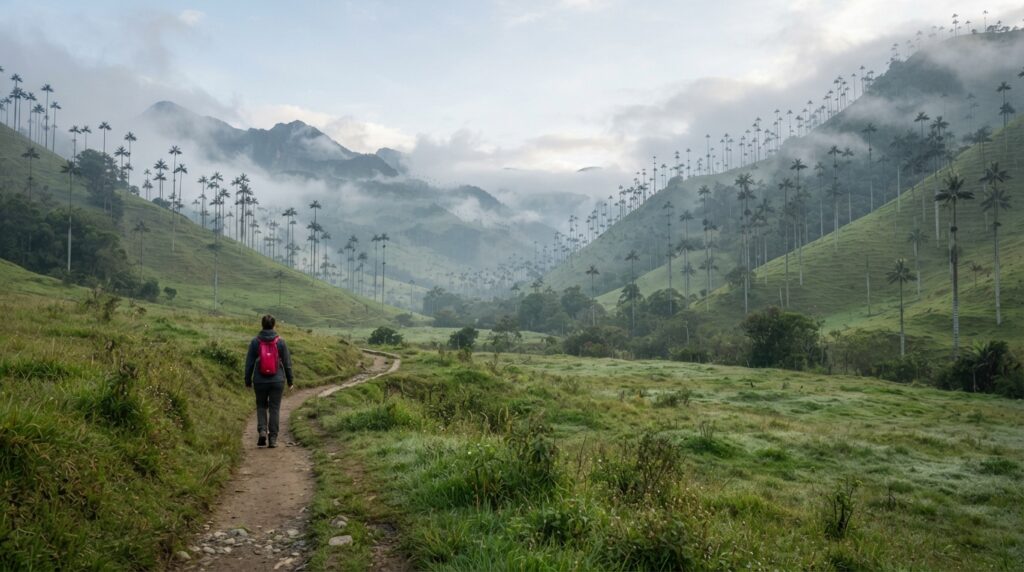
The Coffee Region’s weather can turn wet fast, especially up in Cocora’s cloud forest. A packable rain jacket is the better pick over an umbrella on the trail, since it keeps your hands free.
Shoes for the Cocora Valley
This depends entirely on which hike you’re doing. Near the main entrance is Mirador Manos de Cocora, a paved lookout area with photo spots, nicknamed the “Instagram” or “selfie park.” It’s an easy, short walk for the classic view of the wax palms, and running shoes are all you need.
The full loop hike is a different story. Once you’re into the river sections and the cloud forest, it can get very muddy, and that’s where a pair of proper hiking shoes earns its space. Most guides recommend going counterclockwise: start through the river and cloud forest toward Acaime, and finish with the wax palms. That way you climb the muddiest forest stretches uphill instead of sliding down them.
That’s still a lighter hike than the Lost City Trek, which is often wet, dense and muddy for most of its four days. Don’t pack for Cocora’s full loop like you’re packing for Lost City, but don’t assume the short walk and the full loop need the same shoes either.
Pico’s Local Insight:
“The short walk to see the wax palms is easy and paved, so running shoes are fine. It’s the full loop, through the river and cloud forest, that gets muddy. Most guides recommend starting through the forest toward Acaime and finishing with the wax palms, so the muddiest parts are uphill, not a slippery way down.”
Tayrona: Heat, Bugs and Boat Rides
Tayrona National Park runs hot and humid, with real jungle bugs once you’re past the entrance. A headlamp is worth it for dark campsites and night walks, and insect repellent is not optional here. If your route includes a boat ride along the coast, a dry bag keeps your phone and documents from getting soaked.
Only swim where a beach is marked safe. Some of Tayrona’s beaches have dangerous currents and no lifeguards, and it’s a real risk, not just a sign for show. Tayrona also closes for a few weeks each year, so check it’s open before you go. I stayed just outside the park, and my Santa Marta & Tayrona guide covers where to base yourself.

Pico’s Safety Tip:
“Only swim where a Tayrona beach is marked safe. The currents on some beaches are genuinely dangerous, with no lifeguards.”
Guatapé and Day Hikes
If Guatapé is on your route, the big effort is climbing El Peñol, roughly 700 steps in full sun. Bring water and a hat, and wear shoes with grip, since the steps can be slick after rain. My overnight guide covers the rest.
For something closer to Medellín, the Tres Cruces hike is a solid half-day option. Pack like a normal day hike: water, sun protection and decent shoes.
Health Kit for the Road
A small first aid kit covers cuts and blisters. Electrolytes help on hot, sweaty hiking days, and Gravol (ginger motion sickness tablets) is worth having for winding mountain roads and boat rides if you’re prone to motion sickness. For what to actually get vaccinated for before you go, see my vaccination guide.
What to Leave Off Your Backpacking Colombia Packing List
Some of the bulkiest gear doesn’t need to come from home. Some Salento hostels rent rubber boots, so ask yours if you’re worried about mud deeper in Cocora. Tents and hammocks are rentable in and around Tayrona if you’re camping. Snorkel tours often include the gear, so check before you pack your own. Pack light and fill the gaps locally.
Going Further
If Caño Cristales, the “river of five colors,” is on your list, it’s a whole separate trip, so it gets its own packing list. See my Caño Cristales guide for that one.
Adventure travel in Colombia doesn’t need a huge pack. It needs the right few things and a plan for what to rent instead of carry. For more ideas on where this kind of trip can take you, see my top solo travel adventures in Colombia. Haven’t built your list yet? The quiz does it for your exact route.