
Colombian Hidden Gems
Where are Colombias hidden gems? You’ve walked the walls of Cartagena at golden hour. You’ve hiked through the Cocora Valley with wax palms stretching into the clouds above you. And, you’ve done the Medellín transformation tour and heard the story of how a city reinvented itself. And all of it was incredible.
But here’s the thing… you’ve barely scratched the surface.
Colombia is a country the size of Texas and California combined with Colombias hidden gems scattered across all of it. You have the Caribbean coast on one side, the Pacific on the other, the Amazon basin to the south, and the Andes cutting right through the middle. Desert. Jungle. Indigenous territory that has been inhabited for thousands of years. Simply reducing Colombia to three cities is like reading the first chapter of a novel and calling it done.
The travelers who come back from Colombia talking about how it changed them? They’re usually not the ones who stuck to the highlight reel. They’re the ones who went a little further, stayed a little longer, and said yes when someone suggested a detour.
If you’re already planning a return trip, or maybe even designing your first Colombia itinerary and want to go beyond the obvious, then these five Colombian hidden gems deserve a serious spot on your radar.
1. La Guajira Peninsula – Colombia’s Desert Edge
Most people don’t picture desert when they think of Colombia. La Guajira will change that permanently.
Jutting out into the Caribbean at the northernmost tip of South America, the Guajira Peninsula is unlike anything else in the country. It’s arid, windswept, and striking in a way that feels almost cinematic. With Terracotta sand dunes that roll down into turquoise water, and flamingos feeding in shallow lagoons. The landscape stretches in every direction without a single city skyline in sight.
This is Wayuu territory. The Wayuu people are Colombia’s largest Indigenous group, and their culture is a part of everything here. The handwoven mochilas (bags) seen across the country actually originate here. As a result, visiting La Guajira means engaging with a living, thriving Indigenous community, not just a stroll through a museum.
The two anchors of any La Guajira trip are Cabo de la Vela and Punta Gallinas. Cabo de la Vela is a small fishing village where basic hammock-style accommodation along the water is part of the experience. And Punta Gallinas is the real prize. It’s the northernmost point of South America, where the dunes literally spill into the sea. When you stand here it will feel like the edge of the continent, because it is!
Solo Travel Logistics
La Guajira isn’t a place you navigate independently unless you really know what you’re doing. Most solo travelers access it through organized tours departing from Riohacha, which is easily reached by bus or flight from major cities. The tours handle transportation, accommodation, and meals. Given how remote some areas are, this actually makes the experience better, not more sanitized.
Solo Travel Tip
Look for small group tours of 6–10 people rather than large bus operations. The roads into the peninsula are rough and the infrastructure is ‘rustic’. Without a local guide, you’ll simply see the landscape. With a guide, you’ll truly start to understand it.
2. Jardín – Antioquia’s Best Kept Secret (For Now)
About three hours south of Medellín, down winding mountain roads through some of the most beautiful coffee-growing landscapes, sits Jardín. If you’ve heard people describe Salento as charming, colorful, and quintessentially Antioquian, Jardín is one of those Colombian hidden gems that frequent visitors whisper about but rarely make it into guidebooks. Plus the crowds haven’t found it yet.
The town is built around a main plaza that feels almost impossibly picturesque. The cathedral, the brightly painted balconies. Coffee shops spilling out onto cobblestones, whcih to me makes it looks like a film set, except the people here are just going about their lives. There’s a warmth to Jardín that even veteran Colombia travelers tend to comment on. It’s one of my favourite small towns to visit in Colombia and you should definitely put it on your radar for a overnight getaway.
Beyond the plaza, the real draw for outdoor-minded solo travelers is what surrounds the town. The area is a serious birdwatching destination. The Cock-of-the-Rock (yes, it’s actually called that), one of Colombia’s most visually dramatic birds with its vivid orange plumage, can be spotted in the surrounding cloud forest at dawn. Colombia is one of the world’s top birding destinations overall, and Jardín is one of the best access points in the country without booking an expensive specialist tour.
In addition to birding, the hiking around Jardín leads to waterfalls, mirador viewpoints, and coffee farms offering tastings and farm tours. If you are interested in taking a tour, whcih I highly receommend in jardin, check out my article on Cafe Historias. The town is also small enough to be genuinely walkable. You can drop your bags at your hostel and be in the cloud forest within an hour.
Solo Travel Logistics
Direct buses run from Medellín’s Terminal del Sur to Jardín (approximately 3 hours by bus). The ride itself is worth it for the scenery alone. No complicated connections and no tour required. It’s one of the easier off-the-beaten-path destinations to access independently in all of Colombia.
Solo Travel Tip
Don’t try to do Jardín as a day trip from Medellín. Stay three to four nights instead (if you have the time. Otherwise, try to stay at least one night). The mornings are cool and misty, the afternoons are warm, and the pace of the town rewards slowing down. At least one of those mornings should start before sunrise for the birds, and you’ll thank yourself for building in the time.
3. Minca — The Mountain Above Santa Marta
If you’re making the popular coastal move from Cartagena toward Tayrona National Park, you’re passing through Santa Marta. However, if you push past Santa Marta without stopping in Minca, you’re leaving one of the best experiences on the entire Caribbean coast on the table.
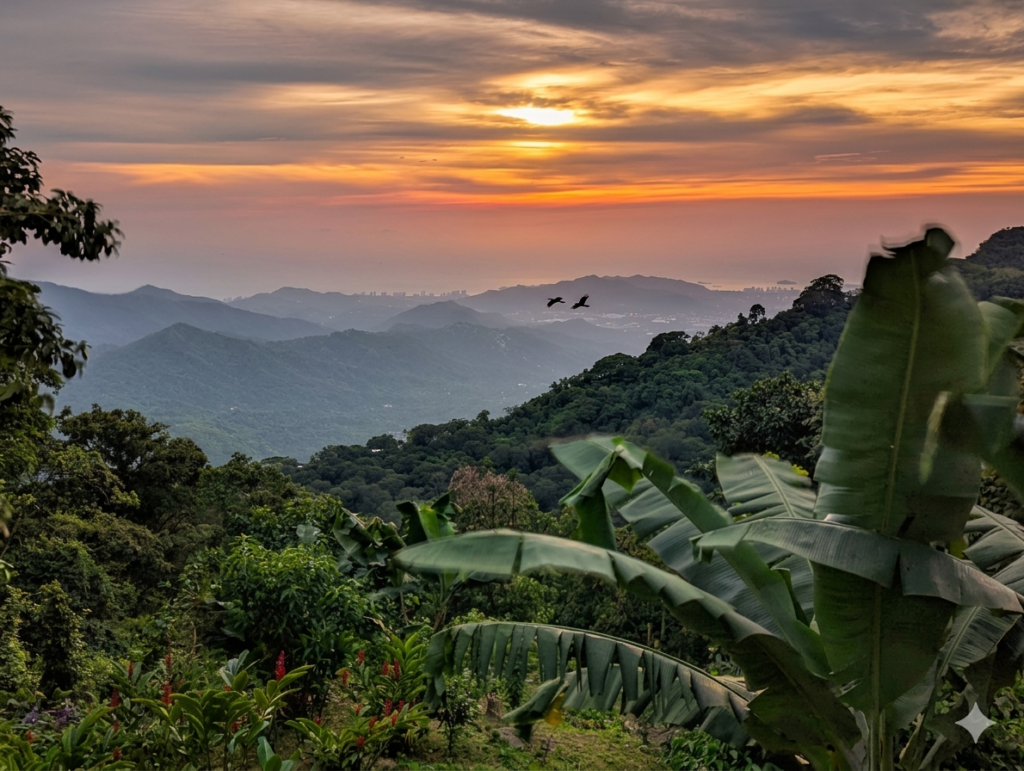
Minca is a small village in the Sierra Nevada de Santa Marta, about 45 minutes from the city. The elevation — not dramatic by Andean standards, but enough — brings a noticeably cooler climate. After days of coastal humidity, that alone feels like a reward. Hammocks hang in the trees, coffee and cacao farms cover the hillsides, and the traveler community here doesn’t feel like a party hostel scene. Every traveler I met in Minca was quietly yet visibly excited. And with the elevation and breathtaking sunset views, it’s no wonder why.
The main draws are natural. Pozo Azul is a series of natural swimming pools where the river water runs cold and clear. Meanwhile, the cacao farm visits have become one of the signature Minca experiences. Some farms offer full chocolate-making workshops whcih take you from raw cacao bean to finished product. It’s the kind of hands-on, local experience that justifies the trip on its own.
The hiking in the area is excellent too. Several viewpoints above the village offer a rare double sighting on clear mornings. These include the Caribbean coast below and the snow-capped peaks of the Sierra Nevada above. Take a moment to let it sink in. Few places in Colombia give you that kind of contrast in a single frame.
Solo Travel Logistics
Buses run frequently from Santa Marta’s main market area to Minca. The ride is short and straightforward, and once you’re in the village, moto-taxis handle transportation to any farms or swimming holes that are too far to walk.
Solo Travel Tip
Minca works beautifully as a two to three day stopover between Santa Marta and Tayrona. It creates a natural rhythm with coast, mountains, and break of what can otherwise feel like a rush through the Caribbean region.
4. Nemocón Salt Mine — Bogotá’s Overlooked Day Trip
Everyone who passes through Bogotá knows about the Salt Cathedral of Zipaquirá. It’s famous for good reason, since it’s an underground cathedral carved into a working salt mine, 200 meters below the surface. It is genuinely spectacular. However, it’s also a full tour bus experience with the crowds to match.
An hour further north of Zipaquirá, most travelers have never heard of Nemocón. If Zipaquirá is on every itinerary, Nemocón is the definition of a Colombian hidden gem, with the same geology, and a fraction of the foot traffic.
The Nemocón Salt Mine has been operational for over 500 years. Interstingly, it predates the Spanish. The Muisca people were extracting salt here long before colonization. The mine stretches 80 meters underground through a series of chambers and tunnels. Some have been transformed into display spaces that tell the history of salt production in Colombia. But, Unlike Zipaquirá, you can actually hear yourself think in Nemocón. The groups are smaller, the experience feels more personal, and walking through a 500-year-old mine without fighting for space lets you actually absorb where you are.
Solo Travel Logistics
Nemocón is an easy day trip from Bogotá. Buses run from the Portal del Norte TransMilenio station and arrive in around an hour. The town itself is small and pleasant and it’s worth a walk after the mine visit before you head back to the city.
Bonus
The town of Nemocón has a charming colonial center that barely registers on the tourist circuit. That combination makes the whole day feel like a genuine local discovery rather than a checked-box attraction.
5. Islas del Rosario (Rosario islands) – Caribbean Island Life, Without the Cartagena Price Tag
Cartagena is one of the most beautiful cities in South America, and it knows it. The prices in the walled city reflect the destination’s popularity. However, after a few days of rooftop cocktails and boutique hotel rates, you start to crave something simpler.
The Rosario Islands are an archipelago about 35 kilometers off Cartagena’s coast. They offer exactly that: Caribbean island life including turquoise water, white sand, fresh grilled fish, and hammocks. All this without the city’s price pressure.
The islands vary significantly from one to the next. Some have developed tourism infrastructure with overwater bungalows and full restaurant service. While others are small enough that you’re essentially camping on a reef. Additionally, the snorkeling across the archipelago is some of the best accessible snorkeling in the Colombian Caribbean. The pace of life here slows to something that actually feels like island time rather than a performance of it.
Solo Travel Logistics
Boats to the Rosario Islands depart from the Muelle Turistico in Cartagena, with most departures in the morning. Day trips are common and easy to arrange. That said, the islands genuinely reward an overnight stay.
Solo Travel Tip
If you can manage a night on the islands, do it. Day trippers leave in the late afternoon. What you’re left with once the boats depart is a completely different experience. One that is quieter, with calm water, spectacular sunsets, and the feeling of actually being somewhere rather than just visiting it between transport connections.
Colombian Hidden Gems: Why the Best Trips Go Beyond the Guidebook
The destinations in this guide aren’t listed here because they’re obscure. They’re Colombian hidden gems in the truest sense. Places that reward the traveler who does a little more research than the average tourist. There’s a version of Colombia that fits neatly in a two-week itinerary: Bogotá, Medellín, Cartagena, Tayrona, done. That version is genuinely good. But the Colombia that stays with you… the one you’re still talking about years later… is the one you found by going a little further than the guidebook told you to.
La Guajira will rearrange your sense of what the country even looks like. Jardín will convince you to add two extra days to your trip. Minca will become the part of the story you recommend to everyone else. Nemocón will make you feel like you found something that wasn’t supposed to be found. And the Rosario Islands will make you question why you were ever in a rush to get back to the city.
Colombia gets richer the more curious you’re willing to be. The destinations above aren’t obscure for the sake of being obscure. No. They’re genuinely excellent. The only reason they’re not more crowded is that most people haven’t been told about them yet.
Now you know. Go and experience it for yourself.
Have you been to any of these spots? Or do you have a Colombian hidden gem that deserves a spot on this list? Drop it in the comments. I read every one.
Thank you very much for this article; it gives me a broader perspective on other places I can visit in Colombia. Colombia is a country rich in biodiversity and culture. Each place offers a unique experience in terms of scenery, cuisine, architecture, and culture. Very helpful.