
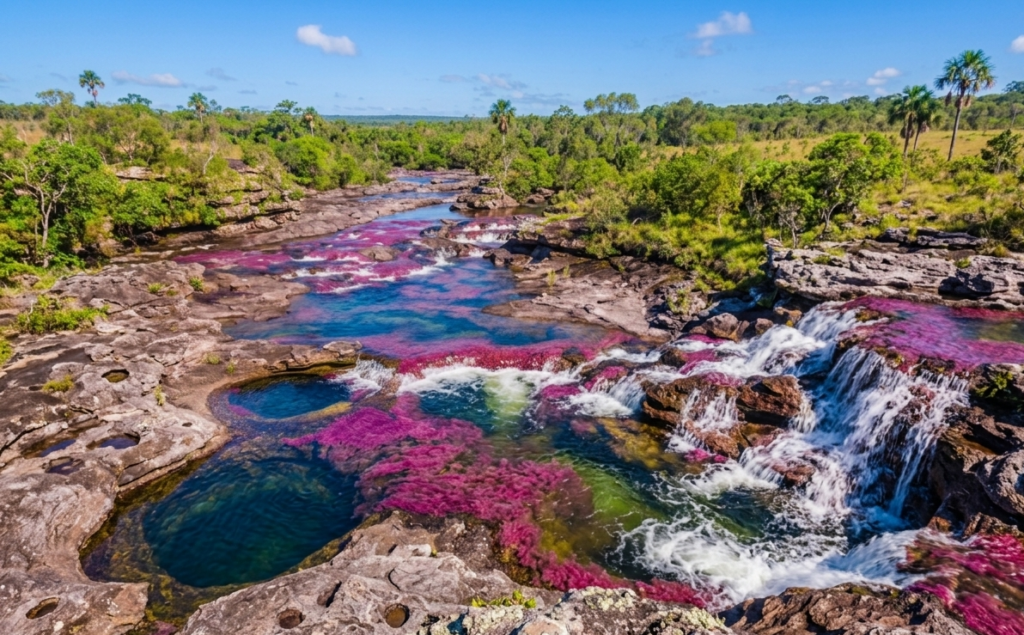
Are you thinking of visiting Cano Cristales in 2026? The first thing most people say when they see a photo of Caño Cristales is: that has to be edited.
It isn’t. The red is real. So is the pink, the yellow, the green, the blue — all of them running through the same stretch of river at the same time, in a remote corner of the Colombian Llanos that most travelers never reach. The river earns its reputation not by being photogenic in the way that everywhere looks photogenic now, but by being genuinely strange. There’s nothing else quite like it.
The reason most Colombia itineraries skip it is logistics. Caño Cristales sits inside Serranía de la Macarena national park, accessed by small prop plane, governed by strict visitor limits and mandatory guided access. You can’t book it the day before. You can’t show up and figure it out at the gate. Getting here requires actual planning — which is, for a certain kind of traveler, exactly the reason to go.
This guide covers everything a solo traveler needs to visit the Colombia rainbow river in 2026: why the colors happen, how the booking process works, what it costs, and what you’re actually walking into when the plane touches down in La Macarena.
What Makes Caño Cristales Look the Way It Does
The colors come from an aquatic plant called Macarenia clavigera. It grows anchored to the smooth sandstone riverbed and produces a crimson-to-pink pigmentation when sunlight passes through shallow, clear water at the right temperature. On its own, that red plant against white sand and blue water would already be striking. What makes Caño Cristales what it is: yellow and green algae sharing the same riverbed, patches of exposed black rock, and the interplay of all of it through fast-moving mountain water.
The seasonal timing is everything. Macarenia clavigera only activates its color during a narrow window when water levels drop low enough for sunlight to reach the plant but high enough to keep the riverbed saturated. That window runs approximately June through December, with peak conditions — the most saturated reds, the sharpest color contrast — running July through October.
Outside that window, Caño Cristales looks like an ordinary river. Inside it, the river earns every superlative.
One more thing worth saying clearly: photographs of Caño Cristales consistently underperform the real thing. Not because the photos are bad, but because the river moves. The colors shift as clouds cross the sun. The light angle changes the reds from crimson to almost orange. The water moving over the plant creates a kind of visual shimmer that no still image captures. You need to see it in person for it to make complete sense — and once you do, you’ll understand why the photos feel flat by comparison.
Visiting Caño Cristales as a Solo Traveler
Solo travel to Caño Cristales works well. Solo and independent are different things, though, and only one of them is permitted here.
All visitors enter the park with a licensed local guide — Colombian law, enforced by park rangers, no exceptions. The regulation exists because Macarenia clavigera is genuinely fragile. Foot traffic on the wrong surfaces, chemical sunscreen introduced into the water, groups moving without direction — each of these has caused measurable damage to the plant. The guided access model is what has kept the river in the condition it’s in despite growing visitor numbers.
For solo travelers, this means joining a small group tour package — typically 6 to 12 people per group. The logistics that make independent travel impossible here (shared flights, licensed guides, fixed routes) also create the conditions that make solo travel particularly good. Caño Cristales draws a certain kind of traveler — curious, organized, willing to go well off the standard circuit — and the small group format tends to produce genuine connections rather than forced ones.
The visitor cap is the detail most people don’t account for when they start researching. The park limits daily entries to protect the ecosystem. During peak season, those slots are fully booked weeks to months ahead of time. Booking early is the most important single action in this entire planning process.
How to Plan Your Caño Cristales 2026 Visit
Step 1: Set Your Dates
July through October for peak color. August and September are the most reliable if your schedule is flexible — the bloom is at full intensity and the weather patterns are more predictable than the edge months. June works but expect less vibrant colors. November and December are the tail end of the season and vary year to year based on rainfall.
Step 2: Choose Your Tour Operator
Packages originate out of Bogotá or Villavicencio. Bogotá-based operators are the easier starting point for most international travelers — more English-language options, stronger review trails, and straightforward booking processes. Villavicencio-based operators tend to offer lower prices and are worth considering if you’re already planning time in the Llanos.
Before booking, confirm your operator is registered with the Serranía de la Macarena national park authority. Any operator offering independent access to the park — without a licensed guide — is operating illegally and should be avoided regardless of the price.
Step 3: The Flight to La Macarena
The town of La Macarena, the access point for the river, has a small regional airstrip. Flights operate on prop planes — 10 to 20 seats — departing from Bogotá’s Aeropuerto Guaymaral or Villavicencio. Flight time is roughly 45 minutes to one hour. Many packages include the flight in the total price. When they don’t, budget $100 to $150 USD round trip.
Book the flight at the same time as the tour. They sell out in parallel during peak season.
Step 4: What a 3–4 Day Package Includes
Standard packages cover accommodation in La Macarena, daily guided hikes to different river sections, all meals, and park entrance fees. The four-day format is better than three — not because three is insufficient for the river itself, but because flight delays in this part of Colombia are common, and a buffer day prevents the trip from unraveling over a rescheduled departure.
Step 5: The Packing List That Actually Matters
Water shoes — closed-toe, grippy, secure — are the most important item. The hikes involve wading through water, crossing wet sandstone, and navigating uneven riverbeds. Sandals slide. Regular sneakers soak through and become uncomfortable dead weight. Water shoes are the one piece of gear worth buying specifically for this trip if you don’t already own them.
Everything else: a dry bag for your phone and camera, reef-safe mineral sunscreen (standard chemical sunscreens are banned inside the park — more on this below), quick-dry lightweight clothing, insect repellent, and a reusable water bottle. Pack for the hike, not the Instagram shot. The bags get heavy.
What Caño Cristales Costs: Solo Traveler Budget
All-inclusive tour packages: $300 to $500 USD. The range reflects operator quality, included vs. excluded flights, and season. The cheapest option isn’t always the wrong one, but guide quality makes a real difference at a park with strict rules and varied terrain — it’s worth reading reviews carefully before selecting on price alone.
Flights to La Macarena (if not bundled): $100 to $150 USD round trip. Book early.
Villavicencio, for extra days before or after: $15 to $25 USD per night at budget guesthouses. Not a destination in itself, but a functional and affordable base that breaks up the travel on either end of the trip.
For context: a Lost City trek from Santa Marta — another bucket-list Colombia experience requiring a licensed guide and multi-day commitment — runs $350 to $450 USD. A multi-day stay at Tayrona with accommodation and fees runs $150 to $250 USD. How to visit Caño Cristales solo costs more than most Colombia experiences, and the argument for the spend is simple: nothing else in the country produces the same result.
What You’re Walking Into on the Ground
La Macarena is a small town. One main street, a cluster of guesthouses, a few local restaurants. The infrastructure exists to support the park and not much beyond it. Within a day, you know the layout. Within two, it starts to feel like exactly the kind of place a trip like this should be anchored in — quiet, functional, completely outside the standard traveler circuit.
The river hikes rotate through different sections each day, distributing foot traffic and giving each group a slightly different experience. Some sections run predominantly red. Others show the full color spectrum simultaneously. The designated swimming areas — cold, clear mountain water surrounded by color — are one of the more genuinely unusual physical experiences available to a traveler anywhere in South America.
The sunscreen rule: no standard chemical sunscreens in the water, full stop. Apply mineral sunscreen in the morning at the guesthouse before you leave. The guides enforce it. The park rangers enforce it. It’s not a guideline — it’s the reason the plant still looks the way it does. Bring your own reef-safe option, because availability in La Macarena is limited and prices are high when you do find it.
Hike difficulty varies by day and route — moderate to demanding, with wet rock crossings, uneven terrain, and sections where you’re wading waist-deep through moving water. No technical skill required. The right footwear and a baseline of physical comfort handle the rest.
The Trip That Earns Its Place in the Story
Caño Cristales requires more upfront effort than anything else most travelers put on a Colombia itinerary. The booking timeline, the small planes, the national park regulations, the specific gear — there are more variables to manage here than a week in Medellín or even a trek to the Lost City.
That friction is also the reason Caño Cristales stays what it is. The visitor cap keeps it from becoming another overcrowded highlight. The mandatory guide system keeps the plant alive. The remoteness keeps the crowd out. There’s no casual path to the Colombia rainbow river, and the river is better for it.
The 2026 season opens in June. Peak slots for July through October fill faster every year. If this is the trip you’ve been turning over in your head, the time to book is now — not when the rest of your itinerary is figured out, and not when you land in Bogotá.
Book the guide. Pack the water shoes. The river will be there. The question is whether your spot will be.
Questions about the trip? Leave them in the comments — I answer every one. The Caño Cristales packing checklist is below with a link to the full packing list article here.
The Caño Cristales Packing List
Everything below is based on what the river actually demands — not a generic Colombia packing guide. Travel light everywhere else on your trip. For Caño Cristales, get these right.
Footwear
- Closed-toe water shoes — grippy sole, secure fit, quick-dry. The single most important item on this list. Don’t substitute with sandals or regular sneakers.
Sun & Skin Protection
- Reef-safe mineral sunscreen — chemical sunscreens are banned inside the park. Buy before you arrive. Stock in La Macarena is limited and expensive.
- UV-protective long sleeve shirt — lightweight, quick-dry. Covers your arms on long river days without the sunscreen reapplication.
- Wide-brim hat — you’re in direct sun for hours.
Gear
- Dry bag — waterproof, for your phone and camera. Non-negotiable on river hikes.
- Reusable water bottle — minimum 1 litre. Refill at the guesthouse each morning.
- Lightweight daypack — something you’re comfortable carrying for 4–6 hours over uneven terrain.
Clothing
- Quick-dry shorts or pants — you will get wet. Cotton stays wet.
- Light rain jacket — afternoon showers are common. Packable is better.
- 2–3 changes of quick-dry clothing — the tour runs 3–4 days. Pack accordingly.
Health & Comfort
- Insect repellent — DEET-based for the Llanos. This is not optional.
- Basic first aid kit — blister pads especially, given the hiking terrain.
- Anti-nausea medication — the prop plane into La Macarena is small and the ride can be rough in certain conditions.
What to Leave Behind
- Standard chemical sunscreen
- Anything you’re not willing to carry on a 5-hour hike
- Valuables — La Macarena has no safe storage facilities