
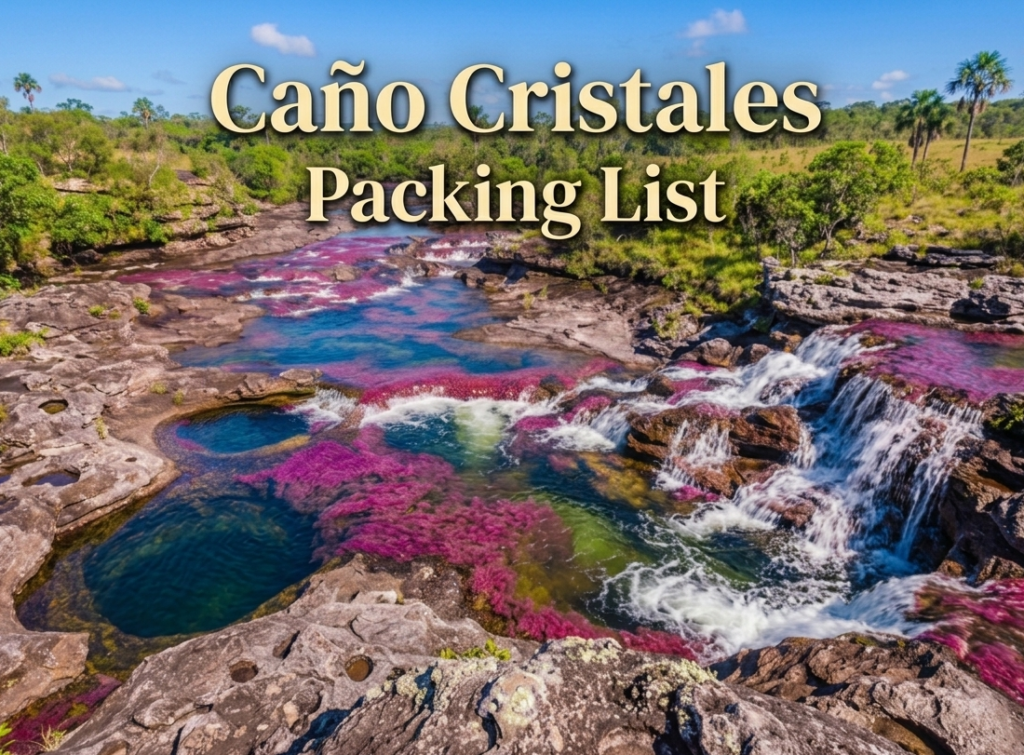
Not sure how to plan your Caño Cristales packing list? Most packing lists for Colombia are written for Colombia broadly, a country with a Caribbean coast, Andean highlands, Amazon jungle, and a dozen climates in between. Caño Cristales doesn’t fit neatly into any of those categories. The national park has its own rules. The terrain has its own demands. The town of La Macarena, accessed by small prop plane and sitting well outside any normal supply chain, means the gear you forget at home stays forgotten.
This list is written for one destination: Caño Cristales. The 2026 season runs June through December, peak bloom July through October. If your trip is booked, this is the list to pack from.
Water Shoes: The Item That Defines Your Trip
Start here, because nothing else on this list matters as much.
The river hikes at Caño Cristales involve wading through moving water, crossing sections of wet sandstone, and navigating riverbeds that are uneven, slippery, and unforgiving of wrong footwear. Sandals lose grip on wet rock. Regular trainers absorb water and stay cold and heavy through the rest of the day. Flip flops are not a consideration.
Closed-toe water shoes with a rubber grip sole and a secure fit are the correct answer. The closure matters as much as the sole, a heel strap that slips mid-crossing on wet rock is a problem. Brands worth researching: Merrell Hydro Moc, Keen Newport H2, Salomon Techamphibian 4. The specs to prioritize are grip, security, and drainage speed.
Buy before leaving home. La Macarena’s retail options are limited, and outdoor gear that does exist there is priced to reflect that reality.
Sunscreen: The Rule That Catches Most Travelers Off Guard
Here is the detail that surprises nearly every first-time visitor: standard chemical sunscreen is banned inside the park.
The active ingredients in most drugstore and pharmacy sunscreens (oxybenzone, octinoxate, avobenzone) damage Macarenia clavigera, the aquatic plant that produces the river’s color. The ban is enforced by guides before every hike and by park rangers on the river. It applies to everyone, every day, regardless of skin type or how hot it is.
Reef-safe mineral sunscreen (zinc oxide or titanium dioxide based) is the only compliant option. It works differently than chemical sunscreen: rather than absorbing into the skin, it sits on top and reflects UV rays. That also means it washes off more easily in water, which is why it’s permitted. Brands that perform well: Thinksport, Badger Sport, Raw Elements, Blue Lizard. Aim for SPF 30 to 50.
Buy mineral sunscreen before arriving in La Macarena. It exists there, but stock is inconsistent and the price reflects a market without alternatives.
Two items that reduce sunscreen dependency on the river:
UPF-rated long sleeve shirt: lightweight, quick-dry, rated UPF 30 or higher. Covers arms through full hiking days without requiring reapplication. Worth the minimal extra weight.
Wide-brim hat: 3-inch brim minimum to cover face, ears, and neck. A buff or neck gaiter rounds out coverage on exposed sections.
Apply sunscreen at the guesthouse each morning before departure. Reapplication on the river is not permitted.
Gear for the River Hikes
Dry bag: A 5 to 10 litre roll-top waterproof dry bag for your phone and camera. A standard daypack zipper does not survive sustained immersion. A dry bag does. Bring one. This is non-negotiable.
Daypack: 20 to 25 litres, padded shoulder straps. The hikes run 4 to 6 hours over varied terrain. Volume is less important than carry comfort, an uncomfortable pack on a long hiking day is a slow, grinding problem that compounds over the tour.
Reusable water bottle: One litre minimum, filled at the guesthouse every morning. The combination of heat, direct sun, and physical exertion on these hikes demands consistent hydration. Don’t underestimate it.
Trekking poles: Not required, but worth considering for anyone with knee sensitivity or balance concerns. Several river sections involve descending wet rock, where poles add real stability and reduce cumulative joint strain over multi-day hiking.
Portable power bank: Charging infrastructure in La Macarena guesthouses is functional but basic. A power bank keeps your phone and camera alive through the full tour without depending on guesthouse outlets.
Clothing
Every item should be quick-dry: Synthetic or merino wool. Cotton absorbs moisture and stays wet. One river crossing in cotton shorts creates a problem that doesn’t resolve until you’re back at the guesthouse. Pack accordingly.
Quick-dry shorts or pants: Two pairs. You will get wet on every hike so plan for it, not around it.
Lightweight shirts: Two to three for a three to four day tour. Merino wool resists odor significantly better than synthetic, which matters when you’re hiking in heat and humidity across multiple consecutive days.
Packable rain jacket: Waterproof, packable to daypack size, under 400 grams ideally. Afternoon showers are common across the Llanos. A jacket that takes up no space solves a real problem when weather arrives mid-hike.
Merino wool hiking socks: The upgrade over regular socks that pays off on multi-day hikes. Better moisture management, lower blister friction, and odor resistance that makes the 3-day tour significantly more comfortable.
Health and Comfort
DEET insect repellent (30% concentration minimum): The Llanos has mosquitoes. The region sits within dengue risk zones during parts of the year. Natural repellents underperform in this environment. Apply before every outing, with emphasis on dawn and dusk exposure.
First aid kit: Blister pads are the most-used item. Pack several, more than you think you’ll need. Add ibuprofen, antihistamine tablets, adhesive bandages, antiseptic wipes, and any personal prescription medications. Medical facilities in La Macarena are limited. A basic kit handles most minor issues without needing them.
Anti-nausea medication: The prop planes into La Macarena are small (10 to 20 seats) and the flight involves low-altitude turbulence in certain weather conditions. If motion affects you in any context, take medication 30 minutes before boarding. Gravol, Dramamine, or equivalent.
Electrolyte packets: The hiking days are long, the heat is real, and water alone doesn’t always maintain energy levels through the afternoon sections. Electrolyte packets added to your water bottle each morning are a small weight for a meaningful return.
Hand sanitizer and wet wipes: Running water at river rest stops is not guaranteed. Compact, takes up almost no space, consistently useful.
What the Park Does Not Allow
The guides brief visitors before entering. These are the items that consistently catch travelers unprepared:
In or near the water:
- Chemical sunscreen: banned, enforced
- Shampoo, conditioner, body wash: same environmental reasoning as sunscreen
- Single-use plastic bottles or packaging
In the park generally:
- Drones: prohibited without specific prior authorization from park authorities
- Loud music or Bluetooth speakers: Caño Cristales is an active conservation area
- Littering of any kind: the park takes waste management seriously
Leave These in Bogotá
- Valuables: La Macarena has no secure storage facilities
- Heavy waterproof hiking boots: overkill for the terrain, slow to dry after river crossings
- Rolling luggage: a 40 to 50 litre backpack or structured duffel is the right format for this trip
- Cotton clothing of any type
- Anything you’re not comfortable carrying for six consecutive hours over uneven ground
The Full Reference List
Non-negotiable: Closed-toe water shoes, mineral sunscreen SPF 30+, waterproof dry bag, DEET insect repellent, reusable water bottle, packable rain jacket, UPF long sleeve shirt, wide-brim hat, quick-dry clothing for 3–4 days, blister pads, basic first aid kit
Strongly recommended: Anti-nausea medication, electrolyte packets, merino wool socks, portable power bank, trekking poles, hand sanitizer, wet wipes, merino wool shirts
Banned or restricted in the park: Chemical sunscreen, soap and shampoo in the river, drones without authorization, single-use plastics, loud speakers
A Note on Priorities
The packing is the easy part. The hard part, the part most travelers underestimate, is the booking.
Caño Cristales operates under a strict daily visitor cap to protect the ecosystem. During peak season, July through October, those spots are gone weeks to months ahead of time. A perfect packing list for a trip that didn’t get booked early enough is a list for a trip that didn’t happen.
If your dates are locked, pack from this list and you’ll be ready for everything the river requires. If you’re still in the planning stage, sort the booking first. Come back to gear once the tour is confirmed.
Don’t miss out. Book early
The 2026 season runs June through December. Book early to reserve your spot. Don’t wait until the last minute or you’ll be dissapointed.