
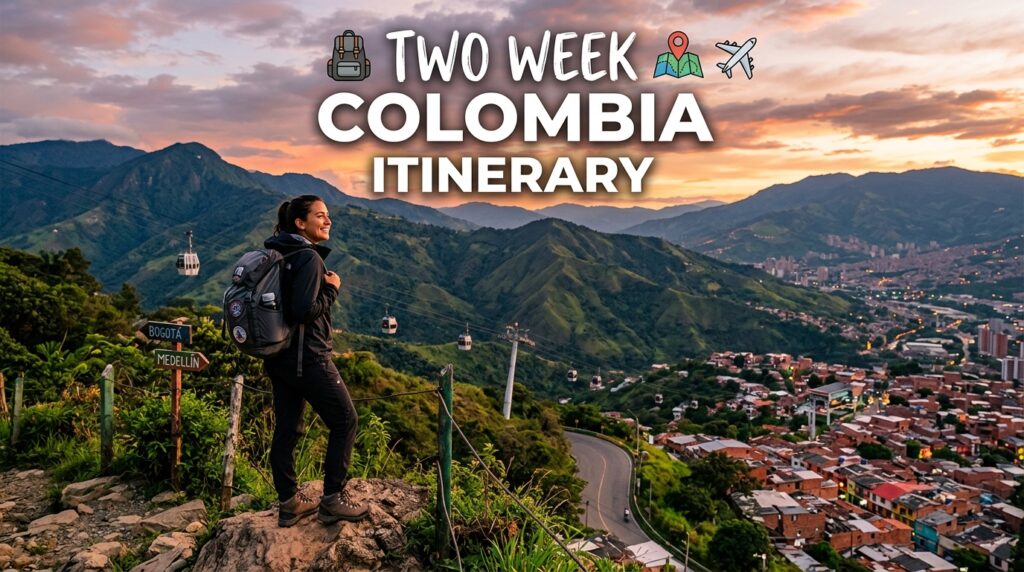
Two weeks in Colombia feels like plenty of time until you open a map and realize how much ground there actually is to cover. Andean mountains, a Caribbean coast, a coffee region that smells like it sounds, and cities that couldn’t be more different from each other if they tried. You could spend two weeks in Bogotá alone and not run out of things to do.
So here’s the route I’d actually tell you to run: Bogotá to start, down to Cartagena and the Caribbean coast, over to the Coffee Region, and finishing in Medellín. Four stops, fourteen days, built around real flight and bus logistics instead of a list of cities that just sound good next to each other. I’ve run versions of this route across seven trips to Colombia, and this is the order that wastes the least time and the least money.
Bogotá and Medellín bookend the trip on purpose. They’re consistently the cheapest cities to fly into and out of, so you save money on both ends just by starting and ending there.
The route at a glance
- Days 1-4: Bogotá
- Days 5-8: Cartagena and the Caribbean coast
- Days 9-11: Coffee Region (Salento)
- Days 12-14: Medellín
Days 1-4: Bogotá
Bogotá is where most international flights land, and it deserves more than the layover treatment most itineraries give it. Base yourself in La Candelaria or Chapinero, spend a morning in the Gold Museum, take the cable car or hike up to Monserrate for the view over the whole city, and wander La Candelaria’s streets for the street art and colonial architecture. Give yourself at least one full day for the food scene too, it’s more ambitious than people expect from a capital city that usually gets skipped in favor of Medellín and Cartagena.
Bogotá sits at altitude, over 8,000 feet, so take the first day slower than you think you need to.
For safety specifics and neighborhood breakdowns, my Solo Travel Safety in Colombia guide covers Bogotá in detail, and the Cultural Pitfalls series will save you from a few rookie mistakes before you even land. For getting around without a car, Bogotá runs on TransMilenio, its bus rapid transit system, covered in more detail in my Sustainable Travel guide.
Getting from Bogotá to Cartagena
Skip the 18-plus hour bus and fly. It’s roughly an hour-and-a-half flight, and with a few airlines running the route daily, you can usually find something affordable if you book a couple weeks out. This is the one leg of the trip where flying isn’t just faster, it’s the obvious call.
Days 5-8: Cartagena and the Caribbean Coast
Cartagena’s walled Old Town is the postcard version of Colombia, colorful balconies, horse carriages, the whole thing, and it’s worth every bit of the hype for a day or two. Getsemaní next door has the better food and the better nightlife, less polished, more local. Spend a day out on the Rosario Islands too, the boat trip out to that stretch of Caribbean water is one of the best day trips in the country.
If you’ve got any flexibility in your schedule, this is where I’d steal a day or two from somewhere else and push north to Santa Marta, Palomino, or Tayrona National Park instead of staying in Cartagena the whole stretch. It’s a different side of the coast, and it’s also where some of the most genuinely sustainable, community-run tourism in the country happens. Indigenous-owned operators like Wiwa Tours and Teyuna Tours run treks into Sierra Nevada communities that most travelers never hear about.
For the safety specifics on Cartagena itself, scams to watch for and neighborhoods to avoid at night, read my Cartagena Solo Travel Scams & Safety Guide before you go.
Getting from Cartagena to the Coffee Region
This leg takes a connection. Most routes fly through Bogotá or Medellín on the way to Armenia or Pereira, the two airports that serve the Coffee Region. Build in a few extra hours for this travel day rather than booking something tight, connections in Colombia don’t always run on time.
Days 9-11: Coffee Region (Salento)
Salento is the town you base yourself in, small, colorful, walkable, and it’s the gateway to the Cocora Valley, home to the tallest wax palms in the world and one of the best day hikes in the country. Give yourself a full day for that hike alone. The other day or two goes to the coffee farms. This is the actual Coffee Region, not just a name, and a real farm tour where someone walks you through the harvest is worth more than any bag of beans you’ll bring home.
A couple of real farms and stays worth booking: Finca El Ocaso is a working coffee estate that runs proper agro-tourism tours, and EcoLodge Kasaguadua is worth a look if you want to stay somewhere that takes sustainability as seriously as the coffee, it runs entirely off-grid inside a nature reserve. Both are covered in more depth in my Sustainable Travel and Best Hostels guides.
Getting from the Coffee Region to Medellín
Skip the flight here, take the bus. It’s about five to six hours from Armenia or Salento to Medellín, and it’s one of the more scenic rides in the country, mountains the whole way. It’s also considerably cheaper than flying, and by this point in the trip you’ve probably got the hang of Colombian bus travel anyway.
Days 12-14: Medellín
Medellín closes out the trip, and it earns the last spot. Ride the Metrocable up into Comuna 13 for the street art and the outdoor escalators, base yourself in El Poblado or Laureles depending on whether you want nightlife or quiet, and take at least one day trip out of the city, Guatapé and its rock, or a hike like Tres Cruces if you want something more physical.
I’ve written extensively about Medellín specifically. My Solo Travel to Medellín guide covers neighborhoods and safety in depth, Tres Cruces Hike is a full breakdown of that day trip, and Hidden Coffee Gems in Medellín will get you past the ordinary coffee shops most tourists never find. Before you go, it’s also worth reading 10 Medellín Scams to Outsmart so you know exactly what to watch for.
Budget Breakdown
Fourteen days across four cities isn’t a shoestring trip, but it’s also nowhere near as expensive as people assume. For the full number-by-number breakdown, flights, food, hostels, activities, I’ve already done that math in my Colombia Travel Costs 2026 guide, and my Top 5 Hotel Booking Platforms post covers where to actually book so you’re not overpaying.
What to Pack
Four different climates in fourteen days: cold mountain mornings in Bogotá, humid heat on the coast, mild days in the Coffee Region, and Medellín’s famous “eternal spring.” My 15 Ultimate Gear Essentials guide covers exactly what earns a spot in your bag for a trip built like this one.
If You Have More Time
If two weeks somehow isn’t enough, or you’re the kind of traveler who wants to see something almost nobody else does, Caño Cristales is worth the extra days. It’s a river that runs red, yellow, and green for a few months a year, and it’s genuinely one of the most unusual places in Colombia. It doesn’t fit cleanly into this route and needs its own dedicated trip out of Bogotá, but if you’ve got the time and the itch for something unique, my Caño Cristales guide and packing list will get you ready for it.
Fourteen days, four cities, and a route built to actually work instead of just look good on a map. This is the trip I’d hand a friend if they asked me where to start in Colombia, and it’s the one I keep coming back to myself. Pick your dates, book Bogotá and Medellín as your bookends, and let the rest of the country fill in the middle.