
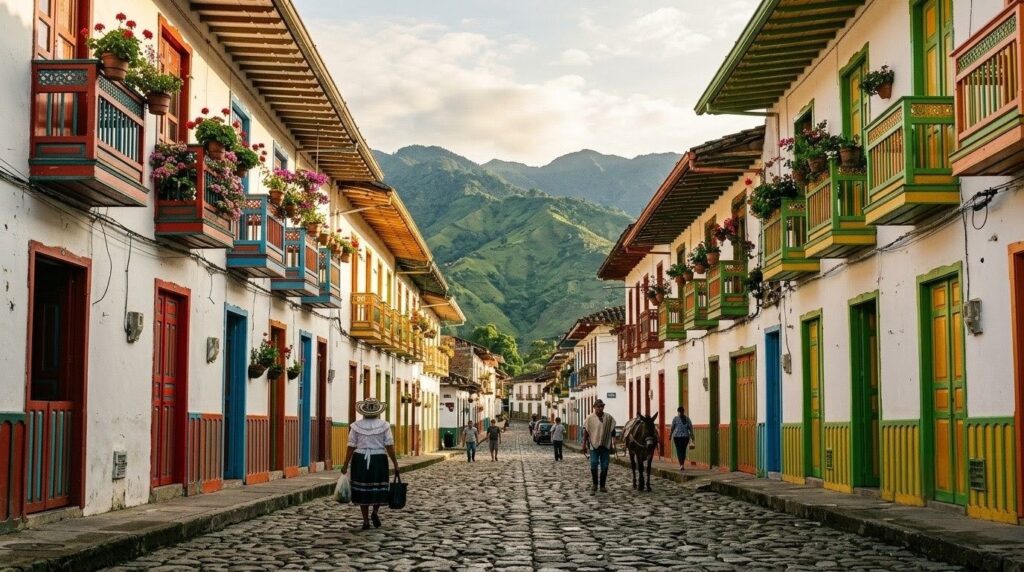
COLOMBIA SMALL TOWNS
Almost everyone runs the same Colombia itinerary. Bogotá, Medellín, Cartagena. Fly in, three or four nights each, done. And look, those cities are great. I’d never tell you to skip them.
But I’ll tell you something I’ve only figured out after six trips down here. The days I actually remember, the ones that stuck, weren’t in the cities. They were in the small towns nobody rushes to. The pueblos most travelers either skip entirely or blow through as a half-day photo stop before hurrying back to their hostel in the city.
The cities blur together after a while. Big plazas, good restaurants, nightlife, museums. Great, but interchangeable. The towns don’t blur. I can still tell you exactly what the light did over the water in Guatapé at six in the evening after the day-trip buses left. That’s the trip.
This is the case for slowing down. For picking a few of Colombia’s small towns and actually staying, two or three nights each, instead of collecting them like stamps. Here are the ones worth your time, and how to string them together.
Guatapé: more than JUST a day trip
Here’s how almost everyone does Guatapé. Bus from Medellín in the morning, climb the big rock, take the photo from the top, eat lunch, bus back before dark. In and out in a day. And they think they’ve seen it.
They haven’t. They’ve seen the rock.
El Peñón is the famous part, the giant granite monolith with 650 steps zig-zagging up the side of it, and yes, the view from the top is ridiculous. All those islands and fingers of blue water spread out below you. Worth every one of those steps, even when your legs are screaming around step 400. Do it. But that’s an hour of your day, not the whole trip.
The town itself is the reason to stay. Guatapé is the most colorful town in Colombia, maybe anywhere, because of the zócalos. Those are the hand-painted panels along the base of every single building, each one telling you something about who lives or works there. A baker’s building has bread on it. A fish shop has fish. Walk those streets slowly and it’s like reading the whole town off its own walls. You cannot do that justice with 40 minutes and a bus to catch.
Then there’s the water. Guatapé sits on a big reservoir, and the lakeside is all kayaks, little boat tours, and waterfront spots to sit with a beer and watch the light go. Stay two or three nights and you get the version of the town that exists after 4pm, once the day-trippers have all cleared out and it’s just you, the locals, and a sunset with nobody in it.
Getting here is easy and cheap. Bus from Medellín’s Terminal Norte runs about 18,000 pesos, call it five bucks, and takes around two and a half hours. Hostels in town start around $10 to $15 a night. There’s no reason to rush this one.
Barichara: Colombia’s prettiest town
If Guatapé is the most colorful, Barichara is the most beautiful, and I don’t think it’s particularly close. This is a colonial town in Santander, off the main Medellín-Cartagena-Bogotá tourist axis, and being off that axis is exactly why it’s stayed so perfect.
Everything is cobblestone. Whitewashed walls, terracotta roofs, wooden doors, all of it immaculately preserved, all of it sitting on a hilltop with views out over the Suárez River canyon. It genuinely feels like someone paused the place a couple hundred years ago and forgot to press play. There’s no rush here because there’s nothing to rush to. You wander, you sit in the plaza, you watch the light change on the stone.
The thing to actually do is the Camino Real. It’s an old colonial-era stone path that runs from Barichara down to a tiny village called Guane, about two hours of downhill walking through dry Santander countryside with big open views the whole way. You walk down, you poke around Guane, you catch a cheap bus back up. One of the best half-days you’ll have in Colombia.
Beyond that it’s artisan workshops, paper-making, stone-carving, sunset from the miradores, and slow meals. Getting here takes a bit of effort, you route through Bucaramanga and then a bus or shuttle out, and that little bit of friction is a feature. It keeps the crowds thin. The travelers who make it to Barichara wanted to be there.
Minca: jungle mountains above the coast
Everybody who goes to the Caribbean coast bases in Santa Marta or Cartagena and stays down at sea level. Minca is the move almost nobody makes, and it’s a mistake, because it’s a completely different Colombia sitting 45 minutes up the hill.
Minca is a small town in the foothills of the Sierra Nevada, up above Santa Marta, where the heat breaks and the jungle takes over. Getting up there is half the fun. You take a mototaxi, a guy on a motorbike, up a winding mountain road with your backpack, and it’s a proper little adventure before you’ve even arrived.
Once you’re up there it’s cacao farm tours where you see how chocolate actually gets made, waterfalls you can swim under, natural pools, and coffee fincas. For the bird people, the Sierra Nevada has something like 600-plus species, and Minca is one of the best places in the country to see them. The hostel scene is relaxed and social in that mountain way, hammocks and shared dinners and other travelers doing the same slow thing you are. Two or three nights up here is the perfect antidote to the coast’s heat and hustle.
Filandia and Villa de Leyva
Two more, quicker, because they’re both worth a stop even if they don’t need a whole section to sell you.
Filandia is Salento’s quieter neighbor in the Coffee Triangle, and honestly, if you’ve been feeling like Salento has gotten too popular for its own good, Filandia is your answer. Same gorgeous Coffee Region setting, colorful balconied streets, a genuinely stunning mirador you climb for panoramic views over the valleys, and a real tradition of basket weaving you can still watch happen. It’s the coffee-town experience without the tour-bus crowds. I’d take it over Salento at this point.
Villa de Leyva is a colonial time capsule a few hours north of Bogotá, and its main plaza is one of the biggest in South America, this enormous open expanse of cobblestone ringed by whitewashed colonial buildings. It’s a popular weekend escape for people from Bogotá, so hit it on a weekday if you can. Beyond the plaza there’s fossil museums (the whole area is loaded with them), desert landscapes just outside town, and easy day trips. A great one to pair with the start or end of a Bogotá leg.
How to actually build a small-town trip
The mistake is trying to do all of these in one go. They’re spread across the country, Guatapé near Medellín, Barichara in Santander, Minca on the coast, Filandia in the Coffee Region, Villa de Leyva near Bogotá, and chaining all five means a lot of your trip is transport.
So don’t. Pick a region and go deep. A clean two-to-three week route that actually flows: fly into Medellín, spend a few days there, then bus out to Guatapé for three nights. From there down into the Coffee Triangle for Filandia and Salento. If you’ve got the time and want the Santander leg, work Barichara in. Or flip the whole thing toward the coast and pair Cartagena and Santa Marta with a few nights up in Minca. Bookend a Bogotá trip with Villa de Leyva.
Transport between towns is buses and colectivos, the shared vans that run regional routes. It’s cheap, it’s how locals move, and it’s reliable if not always fast. Budget-wise the small towns are kinder than the cities. Hostels run $10 to $20, meals are a few dollars, the activities are mostly cheap or free. You’ll spend less per day out here than you do in El Poblado.
The real argument for slow travel is simple. Two nights somewhere is the difference between seeing a place and being in it. One night, you’re a tourist passing through. Three nights, you’ve got a café you go back to, a bartender who knows your order, a sense of the rhythm of the place. That’s the whole thing. That’s why you came.
Give them the time they deserve
The cities are where you land. The small towns are where the trip actually happens.
I’m not telling you to skip Medellín or Cartagena. I’m telling you that if your whole Colombia itinerary is three big cities and a day trip to a rock, you’re getting the highlight reel and missing the film. The pueblos are where you stop being a tourist and start being a traveler, and they only give that back to you if you slow down enough to let them.
Next trip, pick two of these and stay longer than feels necessary. You’ll thank me.
Planning a Colombia trip? I’m building out full small-town itineraries on the blog, the exact routes, buses, and where to stay. And if you want the practical groundwork first, my Colombia cost breakdown and Medellín neighborhood guide will get you set before you go.