
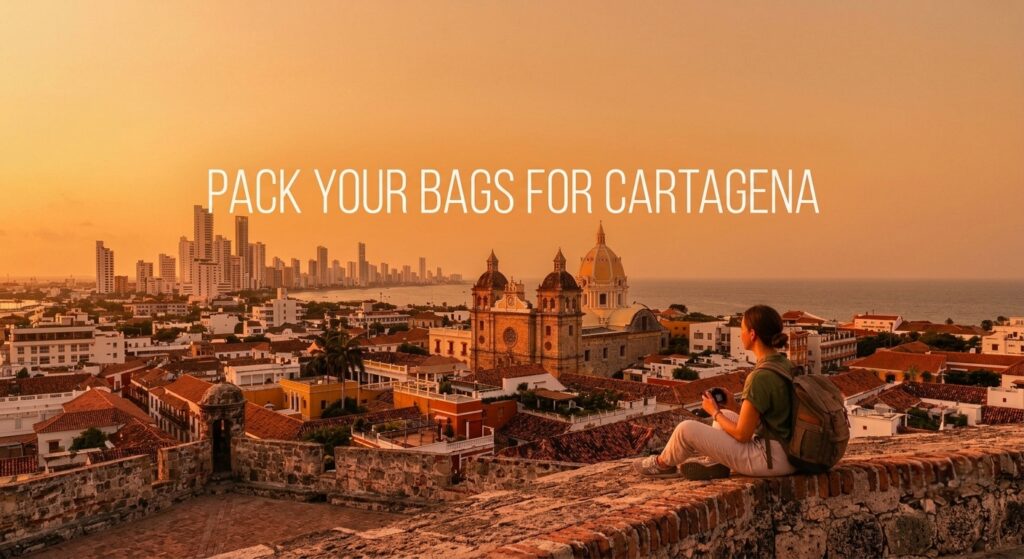
You’re gettign ready to begin your solo travel adventure in Cartagena, one of the prettiest cities in the Americas. It’s also one of the easiest places in Colombia to get scammed. Both things are true at the same time, and anybody who tells you only one of them is either selling you a tour or trying to scare you off a trip you should absolutely take.
I’ve been to Colombia six times. Cartagena is the city I’d send almost anyone to first, because it’s stunning and walkable and the history hits you in the chest. But it’s also the city where I’ve watched more travelers get quietly fleeced than anywhere else in the country. Not robbed at gunpoint. Fleeced. The slow way, twenty bucks at a time, smiling the whole while.
This guide is for the solo traveler who wants the good version of Cartagena. The one where you walk the walled city at golden hour with a fresh juice, not the one where you’re arguing with a taxi driver about a fare he tripled the second he heard your accent. Know the game before you play it and you’ll love this place. Here’s the game.
The scams nobody warns you about
None of these will hurt you. They’re just designed to separate you from your money in ways that feel too small to make a fuss about. That’s the whole trick.
The “free” thing. Someone walks up, friendly, and puts a woven bracelet on your wrist or hands you a hat to try on or offers you a slice of fruit. It’s a gift, they say. Welcome to Colombia. Then they want money for it, and now it’s on your wrist and there’s a small scene brewing and you just pay to make it go away. Don’t take the thing. If it’s already on you, take it off, hand it back, keep walking. “No, gracias” and don’t break stride.
Taxis. This is the big one. Street taxis in Cartagena don’t run meters, so the price is whatever they decide your face is worth. The move is simple: use Uber, or DiDi, or InDriver. The app sets the price before you get in and there’s nothing to argue about. If you genuinely can’t get an app car, agree on the full fare out loud before you open the door, and if the number changes when you arrive, you were always going to have that verbal fight, so have it.
Tour operators. The walled city and the docks are full of guys selling boat trips to the Rosario Islands. Some are legit. Plenty aren’t, and “unlicensed” here can mean an overloaded boat, no insurance, and a “beach club” that’s a shack charging you for lunch you didn’t agree to. Book island trips through your hostel or a real agency with a real storefront. If a stranger on the street is your booking method, that’s your red flag.
The beach. Bocagrande and the public beaches run on pressure. Sunglasses, cigars, massages, a bracelet again, “my friend has a restaurant right there.” A woman will start rubbing your shoulders before you’ve agreed to anything and then present a price. The vendors aren’t dangerous, they’re just relentless, and “no” has to mean no the first time or you’ll be negotiating all afternoon. Firm, not rude. Say it once and mean it.
The ATM “helper.” Someone hovers near the machine, real helpful, offering to walk you through it or telling you this ATM is broken but they know a better one. No. Use ATMs inside a bank branch or a mall, during the day, alone. Anyone offering to help you at a cash machine is helping themselves.
The real safety concerns
Now the stuff that actually matters. Less common than the scams, but worth taking seriously.
Scopolamine. It comes up all the time so it’s worth talking about again. Locals call it burundanga. It’s a drug that wipes your judgment and your memory while you stay awake and functioning, which is exactly what makes it dangerous. People get dosed and then hand over PINs, walk to ATMs, let strangers into their room, and remember none of it. It goes in a drink, on food, sometimes on a flyer or a piece of paper someone asks you to look at. The protection is boring and it works: don’t accept food or drinks from people you just met, don’t leave your drink anywhere, and if you didn’t watch it get poured, don’t drink it. Solo travelers carry more risk here because there’s no friend watching your glass. So you watch it.
Phone snatching. This is the most common street crime you’ll actually see. Guys on motorbikes, sometimes on foot, grabbing phones out of hands and gone before you’ve turned around. The fix is dead simple and almost nobody does it: keep your phone out of your hand on the street. Don’t walk and text. Don’t stand on a corner filming a reel with your arm out. Duck into a café to check the map. A phone in your pocket can’t be snatched.
Nights. The walled city and Getsemaní are lively and fine well into the evening, because there are people everywhere. The trouble starts when you drift to quiet empty streets, or the edges of Getsemaní during late hours late, or the beach after dark. Stay where the people and the light are, and take an Uber the second the crowd thins out. Cartagena at night is about staying in the busy pockets, not testing the quiet ones.
Solo female travelers get a version of this city I don’t. The catcalling is constant and it’s more in-your-face than most Western women are used to. Piropos, hissing, comments. Almost none of it goes anywhere, but it’s exhausting in a way I can’t fully speak to. Women who’ve done Cartagena solo mostly land on the same approach: don’t engage, sunglasses on, headphones in, keep moving, and lean on Uber over walking when you’re tired of being looked at. I wrote a full solo female safety guide separately, because it deserves more than a paragraph from a guy.
Where to stay
Three neighborhoods, three different trips.
Getsemaní is where I’d point a solo traveler first. It used to be the rough-around-the-edges neighbor to the walled city and now it’s the best of both, real character, incredible street art, plaza nightlife, and the highest concentration of social hostels in the city. If you’re solo and want to meet people, this is it. You’ll have a crew by your second night. Look for hostels with female-only dorm options and 24-hour reception; most of the good ones have both.
The Historic Center, inside the walls, the Ciudad Amurallada, is the postcard. Colonial balconies dripping with bougainvillea, the whole thing. It’s beautiful and it’s safe and it’s pricier, and it leans more couples and boutique hotels than backpacker social. Great if you’ve got the budget and want to wake up inside the pretty part. A little quieter socially if you’re on your own.
Bocagrande is the high-rise hotel strip on the water. Modern, air-conditioned, chain hotels, beach access. Almost no character. It’s where you stay if you want a pool and a gym and predictability, or if you’re older and not chasing hostel energy. I wouldn’t put a first-time solo traveler here, you’d spend every evening Uber-ing into the walled city anyway.
What to actually do
Here’s the part you’ve been waiting for. The reason you came.
Just walk the walled city. That’s it, that’s the activity. No plan, no ticket, just wander it slowly and let it be as pretty as it is. Do it early morning before the heat and the crowds, or at golden hour when the stone goes warm and everyone’s out. It’s the best free thing in Cartagena and most people rush it.
Do a Getsemaní street art walk. The murals here are world class and there’s real meaning behind them, the neighborhood’s whole history is on its walls. Free walking tours leave from the plaza; tip your guide well.
The Rosario Islands are the big day trip, an hour out by boat to actual Caribbean water. Book it through your hostel, not off the dock. Worth a full day.
Café del Mar for sunset, once. It’s touristy and the drinks are overpriced and you should go anyway, because it’s built into the old fort walls and watching the sun drop into the Caribbean from up there is the shot. Go, have one drink, get the moment, leave.
Bazurto Market if you want the real, unfiltered city. This is where Cartagena actually shops and eats, no tourists, no polish, kind of overwhelming. Go early, go with a purpose or a guide, keep your phone away, and don’t wear anything you’d hate to lose. It’s not dangerous in daylight with your wits on, but it’s not a stroll either. It’s the most alive place in the city.
And eat. Ceviche from a proper spot, arepas de huevo from a street cart, fresh juice stands on every corner, lulo and maracuyá and mango. The fruit lady with the giant bowl on her head will absolutely charge you tourist rate for a photo, so ask the price first, but the fruit’s real and it’s incredible.
My Cartagena rules
Short version, if you skip everything else.
Uber, not street taxis. Every time.
Phone stays in your pocket on the street.
Agree on the price before anything. The taxi, the tour, the massage, the fruit. Everything.
After dark, stay in Getsemaní or the walled city, where the people are.
Don’t take drinks or food from strangers. Watch your glass.
That’s the whole game. Five rules and you’ve dodged 95% of what goes wrong here.
So, is it worth it?
Yeah. Easily. Cartagena is worth every bit of the hassle, and the hassle is mostly just noise you learn to tune out by day two. The scams are small and the real risks are avoidable and what’s left after you strip all that away is one of the most beautiful, alive, romantic cities you’ll ever walk through alone.
The travelers who leave Cartagena annoyed are the ones who showed up not knowing the game and spent the whole trip a step behind it. You won’t be one of them now. Know how it works, keep your phone in your pocket, and go enjoy the prettiest city in Colombia.