
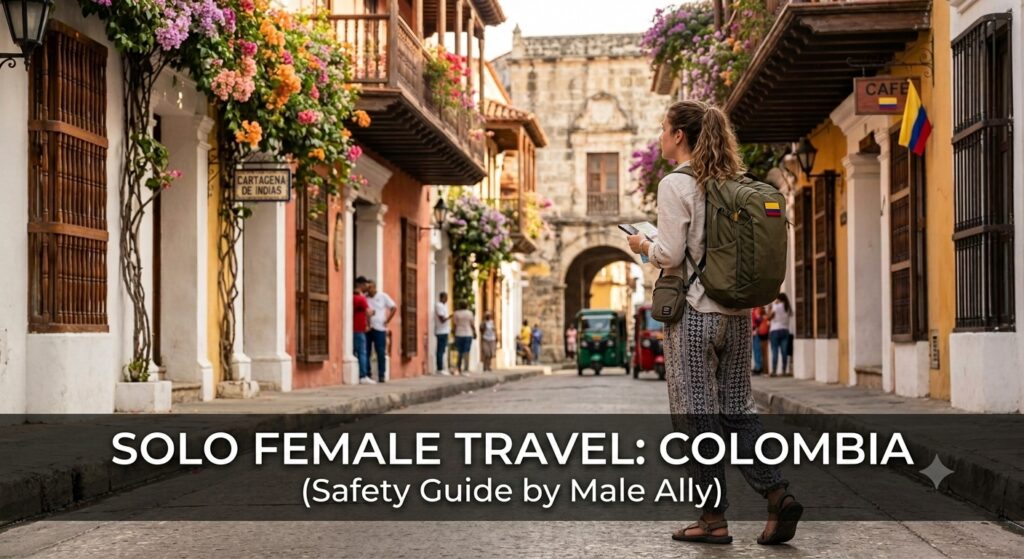
Why I’m writing this, and why I almost didn’t
Let me be straight about something before you read another word. I’m a man. I’ve been to Colombia six times, my wife is from Medellín, and I move through that country in a way a solo woman never will. Nobody catcalls me walking to the gym. I don’t think about how dark it is before I decide to walk three blocks. My experience is not the experience this article is about, and I won’t pretend otherwise.
So why write it at all?
Because this is the single most common question I get from women who follow my Colombia content, and waving it away with “just be careful” would be useless to them. I’d rather do the work. This guide is built on three things: the published accounts of women who’ve actually traveled Colombia solo, conversations with female travelers and with the women in my own life who know that country intimately, and the current 2026 safety data from official sources. Where I’m relaying someone else’s lived experience, I’ll say so. Where the data is clear, I’ll give it to you straight.
I’m not here to tell you Colombia is perfectly safe, and I’m not here to scare you out of a trip that thousands of women take successfully every year. I’m here to give you the honest version, the one that respects you enough to assume you can handle the truth and make your own call.
The reality
Colombia is navigable for solo female travelers. It is also a place that asks more of you than Portugal or Japan or Costa Rica. Both of those things are true at once, and any guide that only tells you one of them is selling you something.
Thousands of women travel Colombia alone every year and come home with the trip of their life. The tourist infrastructure has grown enormously, Medellín welcomed over a million foreign visitors in 2025, and in the main neighborhoods you’ll be surrounded by other travelers doing exactly what you’re doing. The fear most people carry about Colombia is calibrated to the 1990s, not to 2026. Pablo Escobar has been dead for over thirty years. Medellín’s homicide rate is now lower than several major US cities.
THe truth
Street harassment is real and it’s more persistent than most Western women are used to. Machismo culture means catcalls, hisses, and comments will happen with regularity when you’re alone, and it can feel aggressive even when it doesn’t escalate. Most of the time, ignoring it is the right and safe move, and it stays verbal. But it’s draining in a way that’s hard to explain until you’ve lived a few days of it.
I’ll also pass along somethign worth taking seriously. Some very experienced female travel writers, women who’ve traveled the world solo for years, specifically do not recommend Colombia as a first solo trip. Their reasoning is that the country rewards experience and decent Spanish, and that it’s a tougher place to learn solo travel from scratch than somewhere like Mexico’s Yucatán or Southeast Asia. I think that’s fair advice. If this is your very first time traveling alone, Colombia can absolutely be done, but go in with more planning, more budget for safety, and ideally a few group tours built into your first days.
The highlight of almost every account I’ve read is the same: the risk here is mostly preventable. Not entirely (nothing is), but the women who have problems and the women who don’t are usually separated by a handful of specific, learnable habits. The rest of this guide is those habits.
The scopolamine conversation
This is the part I refuse to soften, because it’s the one that matters most.
Scopolamine, known locally as burundanga or “Devil’s Breath,” is a drug that strips away your judgment and your memory while leaving you conscious and able to function. Under its effects, victims willingly hand over PINs, walk to ATMs, let strangers into their accommodation, and remember none of it afterward. The Government of Canada’s 2026 advisory describes victims being incapacitated and disoriented for 24 hours or more, with overdoses reported.
Most coverage frames scopolamine as a problem for men, because the highest-profile cases involve men lured through dating apps. That framing is dangerous for women, because it makes you think this isn’t your problem. It is. The drug is used against women too, through spiked drinks and robbery, and the worst-case outcomes for women include sexual assault. You need to take this as seriously as any male traveler does, arguably more so.
How it’s administered is the part people get wrong. It’s not only drinks. It can be:
- Slipped into a drink you left unattended, or a drink handed to you
- On food, gum, cigarettes, or a flyer passed to you
- On a piece of paper or a phone screen someone asks you to look at, “Can you help me with directions?”
- Blown into your face as powder at close range
Practical advice
The practical prevention is simple to state and requires real discipline to follow. Never leave your drink unattended, not for a bathroom trip, not while you dance. If you didn’t watch it being made and carried, don’t drink it. Buy your own drinks and carry them yourself. Be wary of accepting anything, and I mean anything, from a stranger or a new acquaintance, including help that involves you touching their phone or paper. The official advice is blunt: be suspicious of snacks, beverages, gum, cigarettes, or anything else offered by someone you just met.
Why does this hit solo travelers harder? Because there’s no buddy. When you travel with someone, you have a built-in system, one of you watches the drinks, one of you notices when the other is acting strange, one of you can get help. Alone, you’re both the target and the only safety net. That’s not a reason to avoid Colombia. It’s a reason to build your own systems, which is what the playbook section is for.
City by city
Colombia is not one place, and the safety picture shifts a lot depending on where you are.
Bogotá

The capital is big, high, and demands street awareness. Stay in Chapinero or the Zona G / Zona T areas, where solo female travelers consistently report feeling comfortable day and evening. La Candelaria, the historic center, is worth seeing in daylight but is not where you want to wander after dark. Specifically avoid San Bernardo, Ciudad Bolívar, and El Tunal.
Two Bogotá-specific notes. The altitude sits around 8,600 feet, which means alcohol hits you faster and harder than you expect, an underrated safety issue when you’re out alone. Pace yourself. And on the TransMilenio, the bus system, keep your phone away and your bag in front of you; pickpocketing is the routine crime there.
Medellín
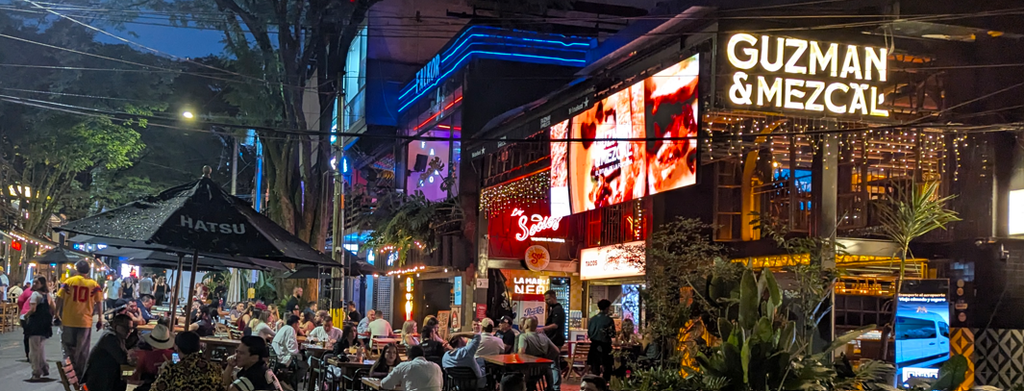
The city I know best. For a solo woman, base yourself in El Poblado or Laureles, full stop. These neighborhoods are busy, well-policed, and full of other travelers. El Poblado is the easy landing pad with the most English; Laureles is a touch more local and, many women find, more relaxed once you’ve got your footing.
Nightlife is where the rules tighten. Parque Lleras is the nightlife hub and also where the most problems cluster late at night. Go if you want, but treat it as a place with a plan: arrive by Uber, keep your drink in your hand and your eyes on it, and leave by Uber. Avoid walking the uphill streets between Lleras and Provenza alone after dark. Skip El Centro after sunset entirely. Avoid the northeastern comunas, Aranjuez, Castilla, Manrique, which have active gang issues and no reason for a tourist to be there.
Cartagena
The Walled City (Ciudad Amurallada) and Getsemaní are the tourist heart and are generally comfortable for solo women during the day and into the evening, though Getsemaní gets rowdier at night. The heat pushes people toward beachwear, but the standard advice still helps you avoid hassle. Expect persistent street vendors on the beaches and in the old town; a firm, polite “no, gracias” and continuing to walk is the move. Be cautious with the Bocagrande beach scene and very cautious about isolated beach stretches alone.
Salento and the Coffee Triangle
The gentlest part of the country for a solo woman. Salento, Filandia, and the broader Eje Cafetero run on tourism and small-town community energy. Lower crime, friendlier pace, easier to meet other travelers on coffee farm and Cocora Valley day tours. If you want to start your trip somewhere that lets you build confidence before the big cities, start here.
The practical playbook
This is the part to screenshot.
Transportation. Use ride apps, not street taxis, especially at night. Uber, Cabify, DiDi, and InDriver all operate. When you get in, screenshot the driver and plate details and share your trip status with someone. Confirm the driver says your name rather than you saying it first. Never hail a cab off the street after dark.
Accommodation. Choose places with 24-hour reception and good, recent reviews from solo women specifically. Many hostels offer female-only dorms, worth it for both safety and peace of mind. Read reviews for mentions of the surrounding blocks at night, not just the property. A great hostel on a sketchy street is still a sketchy walk home.
Dress. I’m not going to tell you what to wear, and anyone who frames modesty as a safety guarantee is lying to you. What I’ll pass along from women who travel there: most Colombian women wear jeans rather than shorts or short dresses, even in the heat, and dressing closer to the local norm draws less attention. Leave the expensive jewelry and the flashy watch at home. This isn’t about blame, it’s about not advertising yourself as a wealthy, distracted target.
Communication. Get a local SIM or eSIM on arrival (Claro and Tigo have the best coverage) so you’re never stuck without data to call a ride or a contact. Set up a simple check-in schedule with someone back home, a daily message, or a “if you don’t hear from me by X, here’s what to do.” Keep your accommodation address saved offline and a few key Spanish phrases ready.
Nights out. The highest-risk window is late at night, so this is where discipline pays off most. Pre-plan your transport home before you go out. Watch your drink the entire time, and if you lose sight of it, abandon it. If a situation or a person feels off, trust that instinct immediately, it’s not rude, it’s smart. And if you’re robbed, hand over what they want without resistance. Your phone is replaceable. You are not.
What female travelers actually say
I leaned on a lot of women’s published accounts to write this, and the picture they paint is consistent and worth summarizing honestly.
The recurring theme from women who’ve done it is that Colombia is doable and deeply rewarding, but that it demands more active awareness than many other destinations, the sense that you’re “switched on” in a way you might not be in Lisbon or Chiang Mai. Several describe street harassment as the most constant low-grade annoyance, more wearing than dangerous, and most settle on the same response: ignore it, don’t engage, the men are fishing for a reaction.
There’s also genuine disagreement among experienced women, and I think you should hear it rather than have me flatten it. Some seasoned solo travelers are enthusiastic and say they never felt seriously unsafe sticking to the tourist trail. Others, equally experienced, caution that Colombia is exhausting to navigate as a woman and not the place to cut your teeth on solo travel. Both groups are telling the truth about their own experience. The reconciliation, as far as I can tell, is that preparation and Spanish and city-smarts move you firmly into the first group.
What almost none of them say is “I regret going.” The women who keep returning talk about the warmth of people once you’re off the harassment-prone streets, the landscapes, the music, the sense of having done something that took some nerve. The empowerment isn’t despite the difficulty, it’s partly because of it.
So, should you go?
Colombia rewards preparation more than almost anywhere I travel. That’s the honest summary. It will not hand you a frictionless trip the way some destinations do, but it gives back enormously to travelers who show up switched on, do a little homework, and respect the place for what it actually is in 2026 rather than what a Netflix show made it.
If you’re an experienced solo traveler with some Spanish, you’ll likely be fine and probably fall in love with it. If it’s your first solo trip, do it with extra scaffolding, group tours early, easier cities first, more budget allocated to safe transport and accommodation. Either way, the habits in this guide aren’t about living in fear. They’re about removing the small, preventable risks so you’re free to enjoy the rest.
I can’t tell you what it feels like to travel Colombia as a woman. But I can do the research, listen to the women who know, and hand you the most honest version I’m capable of. That’s what an ally with a platform owes you.
Before you go: I put together a free Solo Female Travel Safety Checklist for Colombia (see button below), every practical item from this guide in a printable, screenshot-friendly format you can keep on your phone. Grab it below. And if you want the deeper city breakdowns, my Medellín neighborhood guide and Colombia cost breakdown go further on where to stay and what to budget.
Travel smart. Have the trip.